Reflection of the Month - Shaykh Paul Armstrong
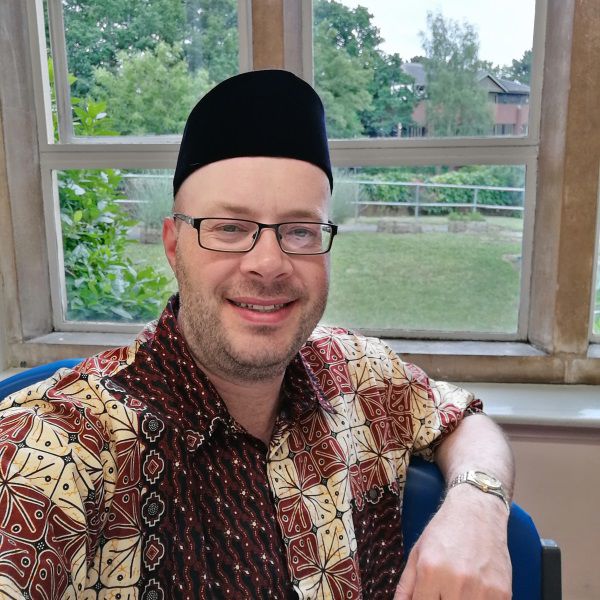 Shaykh Paul Salahuddin Armstrong, Muslim Chaplain
Hajj, Sacrifice, and the Orbit of Love
Over the past week, Muslims around the world have celebrated Eid al-Adha at the culmination of the Hajj pilgrimage. Yet there is a dimension to these sacred rites that is not discussed nearly enough.
Why do Muslims go on Hajj? Why do we celebrate Eid al-Adha?
Most Muslims can readily recite the Five Pillars of Islam. We bear witness that there is no god but God and that Muhammad is His Messenger. We pray, fast in Ramadan, give charity, and, if able, undertake the pilgrimage to Makkah. Yet these are not merely religious duties. Beneath them lies a profound spiritual meaning. Let us reflect a little deeper.
When Muslims travel to Makkah to perform Hajj or Umrah, do we glorify a building? Are we revering bricks and stone? Certainly not.
The Kaaba is sacred, but not because of its physical materials. It serves as a focal point of worship, a direction towards which Muslims unite in prayer. Islamic tradition teaches that it mirrors the heavenly House (al-Bayt al-Ma'mur), around which the angels continually worship God. The earthly Kaaba is therefore a sign, a symbol, and a point of orientation; it is not the object of worship itself.
The Quran reminds us, “To God belong the East and the West, and His face is wherever you turn. God is Infinite, All-Knowing.” (2:115) When pilgrims arrive in Makkah, they proclaim, “Labbayka Allahumma Labbayk” (Here I am, God, here I am) These words reveal the true purpose of Hajj. The pilgrim is not presenting himself before a building. He is presenting himself before his Lord.
Historically, the journey to Hajj demanded immense sacrifice. Pilgrims travelled for months, sometimes years, facing deserts, storms, disease, and uncertainty. Modern transportation and accommodation have made the journey considerably easier, yet it still requires effort, expense, patience, and commitment. Why undertake such a journey? Because love compels people to make sacrifices. The pilgrim's journey is an outward expression of an inward longing.
One of the central acts of Hajj is tawaf, the circumambulation of the Kaaba. Yet this act is not unique to Islam. Throughout history, people of many faiths have made pilgrimages. Christians journeyed to Jerusalem and other holy sites. Jews travelled to the Temple in Jerusalem. Hindus perform circumambulation around temples and sacred places. Buddhists travel to holy shrines and stupas. Why?
At their best, such journeys arise from a desire to draw nearer to the Divine, they are expressions of devotion, remembrance, longing, and love. Eid al-Adha teaches a similar lesson, Muslims commemorate the willingness of prophets Abraham and his son Ishmael to submit themselves to God. According to the Quran, when Abraham saw in a dream that he must sacrifice his son, Ishmael responded, “My father, do as you are ordered. You will find me, God willing, patient.” (37:102)
This was not a story about cruelty, nor was it a story about God desiring human sacrifice. Indeed, God intervened before any harm could occur and provided a ram in place of Ishmael. The story is about love and trust. Abraham loved God so deeply that he was willing to surrender everything. Ishmael loved both God and his father so deeply that he was willing to place his trust entirely in them. The sacrifice was never about blood.
The Quran itself states, “It is neither their meat nor their blood that reaches God: what reaches Him is your piety.” (22:37) Every parent understands sacrifice. Every caregiver understands sacrifice. Every person who serves their community understands sacrifice. Whenever we give our time, energy, wealth, comfort, or convenience for the sake of someone we love, we are sacrificing. Love is what gives sacrifice its meaning. We do not willingly sacrifice for people we do not love, nor do we sacrifice for any god we do not love.
Returning to the symbolism of tawaf, there is another reflection worth considering. Pilgrims circle the Kaaba, yet when we look up into the heavens, we see that creation itself is engaged in a kind of cosmic tawaf. The moon circles the Earth, the Earth circles the Sun, the Sun, together with countless stars, orbits within our galaxy. Our galaxy moves through the cosmos alongside other galaxies. Throughout creation, from the smallest scales to the largest, we find patterns of orbit, motion, and relationship.
Science explains these movements through gravity and the laws established by God within creation. Yet for people of faith, these laws themselves point towards a deeper reality. The Quran declares, “And It is He who created the night and the day and the sun and the moon; each floating in its orbit.” (21:33) And elsewhere, “There is nothing which does not glorify Him with praise, but you humans fail to understand the manner of their glorification.” (17:44)
The universe is not random chaos. It is ordered, harmonious, and directed. The pilgrim circling the Kaaba is, in a sense, joining a cosmic pattern already woven into creation itself. The language of science may describe attraction, gravity, and orbital mechanics. The language of spirituality speaks of longing, remembrance, and love. Both point towards a universe held together by the wisdom of its Creator; Hajj reminds us of this truth and Eid al-Adha reminds us of this truth. Both call us beyond ritual into relationship; beyond obligation into devotion; beyond outward actions into inward transformation.
Ultimately, the journey of faith is a journey of love.
May God make us among those whose hearts are drawn towards Him, whose sacrifices are accepted by Him, and whose lives become reflections of His mercy, kindness, and compassion. Amin.
Quotes of the Quran taken from The Qur’an: A Contemporary Understanding by Safi Kaskas
This reflection was written by Shaykh Paul Armstrong, one of our Muslim Chaplain. You can find out more about Shaykh Paul by clicking here to visit his profile.
The views expressed in this reflection are those of the Chaplain and do not necessarily represent the position of the University of Birmingham's Multifaith Chaplaincy.