Blog: School of Government students win four awards at prestigious International Model NATO
Written by Becca Hills
In February 2026, I had the honour of representing UoB, along with five other students, at the 41st Annual International Model NATO (IMNATO) Conference in Washington D.C. Here, we joined 17 other teams from universities across the USA, Belgium and Canada for a four-day event of intense debating and diplomacy. Guided by Professor Mark Webber, our team represented Lithuania and came away successfully, winning the Overall Superior Delegation Award, as well as three individual awards.
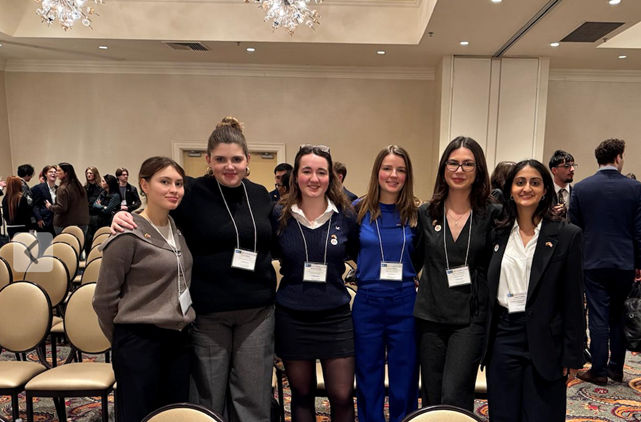
What is IMNATO?
IMNATO is a NATO simulation that brings together students from universities across multiple countries. Delegations represent nations of NATO across six committees, learning how the NATO alliance works and responds to security issues around the world. IMNATO, in other words, highlights the challenges that NATO faces today. Its deliberations are consensus-based, meaning a policy must be accepted by all delegates to pass.
Why did I apply?
I saw the opportunity through the weekly POLSIS (Political Science and International Studies) newsletter and was eager to apply for multiple reasons. Firstly, I recognised the uniqueness of this opportunity as UoB is the only UK university to attend. I also saw IMNATO as a way of learning beyond a lecture hall and a means to immerse myself into the workings of real-life politics. Being able to do this in Washington D.C was incredible. It also gave me the chance to extensively research the politics of Lithuania, which I admittedly knew little about before, enhancing my understanding of global politics.
Preparation
After selection (which involved a written application and interview), we met as a group a few times to prepare, which was essential. We decided on committee representations, worked out logistics, and discussed the political position of Lithuania. The amazing Lucy Pearson (a Model NATO veteran) also gave us a session on the event’s rules of procedure, something which took a while for us to get our heads around. There was complicated language that we had to adopt, as well as abandoning the use of personal pronouns which felt unnatural at first. Lucy did some great exercises with us to get used to the different styles of debates, using examples like what different delegations wanted for dinner! We also had a working document to focus our research, ensuring that we were all unified in our approach towards Lithuania.
Once in Washington D.C
When we all had convened in the Washington Plaza Hotel (the venue and accommodation for the event), the action started. After a team meeting, we were invited to the Lithuanian Embassy in Washington, where we had the honour of meeting the Lithuanian Ambassador, Gediminas Varvuolis. After our initial shock of being able to meet someone so influential in Lithuania, we sat down with him for around forty minutes, where he discussed our agenda and answered our questions around how he wanted us to represent Lithuania. The ambassador took the time to address us all individually, talking to us in depth about how our agenda had a real-life impact on Lithuania and its people which was inspiring to hear before debate in committee. It was a major highlight of the trip for us all.
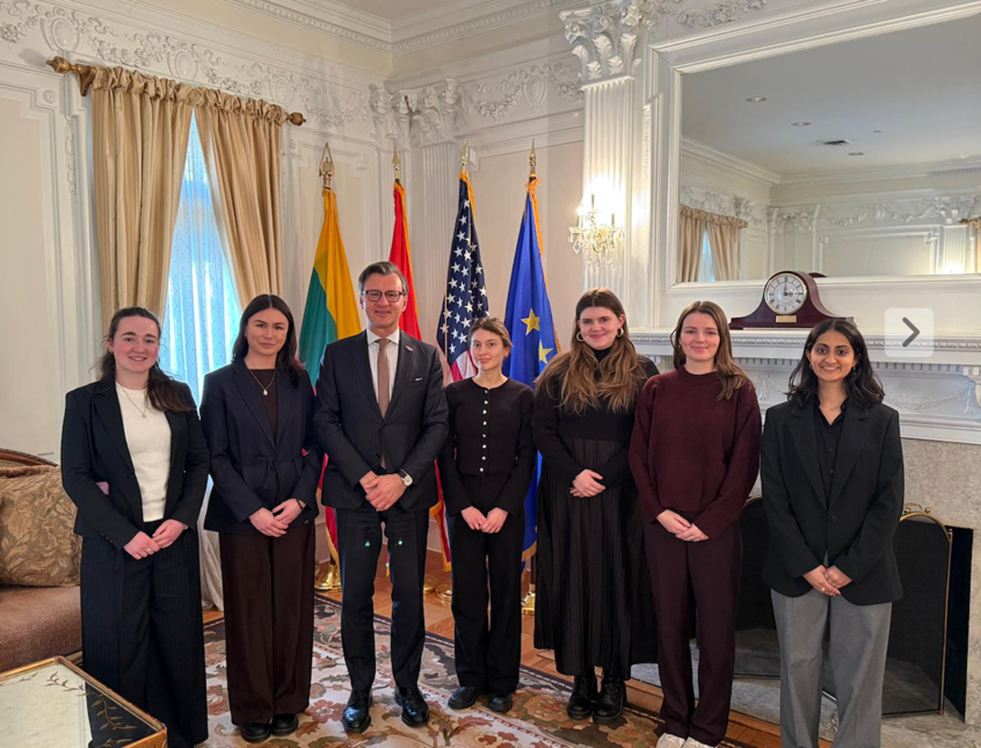
We also had numerous other highlights, such as an alumni event that the university set up for us to connect with UoB alumni based around the Washington area. We also had the privilege of listening to James Townsend, the keynote speaker, who has played numerous roles within NATO. Hearing his insights around the importance of NATO and how much we were going to gain from this experience was incredibly inspiring.
The actual debating proceeded over three days, with our individual committees convening to discuss and debate policy on our agenda items. It gave us insights into the challenges of diplomacy and how to manage intense discussions, whilst strictly sticking to our Lithuanian position. It was essential to build alliances with other delegations through discussions – even out of session. It was often hard at times to navigate discussions to ensure complete consensus, however we handled the pressure well, and produced strong policies which we were all proud of.
Reflection and insights
This experience has been invaluable to me, and I have been so lucky to take part. I’ve been able to create strong bonds and connections with both my team and students across many universities. I have also gained a strong interest in defence and diplomacy, opening my eyes to possibly completing a Master’s in this area (having been inspired by the Master’s students in the UoB team) as well as an eagerness to involve myself in other model NATO events that the University offers in POLSIS.
We have all come away with new skills, highly transferrable to many aspects of our degrees in POLSIS. For this, I am very grateful. I would highly recommend anyone who has an interest in any aspect of this event to apply and get themselves involved in future Models (a number are offered in the School of Government each academic year). It was truly a unique experience, one which has been very advantageous to my future aspirations and career goals.