#UoBWomen: Black women in medicine
Written by Aliyah Opesade
March marks Women’s History Month. A month to celebrate how far women have come, but also to reflect on where we are still falling short.
As of March 2025, women in the UK now make up the majority in medicine, which is a significant milestone for both the profession and patients! For decades, medicine was a male-dominated profession; lecture halls filled with men, leadership boards dominated by men, research shaped largely by men. So, seeing more women entering medical school and overtaking the medical workforce is definitely worth celebrating.
Not only that, but the number of black and minority ethnic doctors has reached record highs. However, they remain underrepresented in senior consultant positions.
As a black woman in medical school, I exist within both truths. I am part of the progress but still part of the minority.
It is empowering walking into a small group session or lecture theatre and seeing so many women training to become doctors. It tells me that the old stereotypes about who is “naturally suited” to science or leadership is being challenged and reminding me that barriers can shift.
Representation within representation matters
Whenever I look at senior consultants, academic leads, or medical leadership, the faces don’t always reflect the broad diversity of the patients we serve. And that lack of representation can feel heavy. Not at all because I doubt my own ability, but because belonging isn’t about entry. It’s about seeing someone who looks like you in places of authority and thinking, I can do that too.
Progress that benefits some women more than others isn’t the finish line. This is why intersectionality matters in medicine because a black woman in medicine may face challenges that her white female and male peers may not experience in the same way. From subtle micro-aggressions to assumptions about competence, these experiences can accumulate quietly, often invisible to those who don’t regularly experience them.
And yet, despite this, we continue to show up and excel. We lead university societies. We present research. We create spaces for others.
Nike Ajijola, President of UoB’s African Caribbean Medical Society
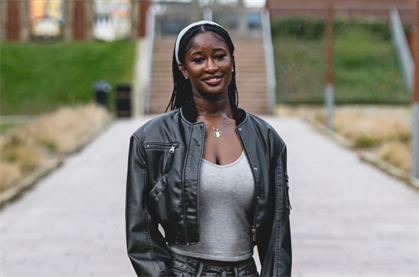
A woman I would like to highlight in this blog is Nike Ajijola, President of the African Caribbean Medical Society at UOB. Apart from holding a leadership position, she is recently a published author and delivered her first poster presentation at an international conference! Her achievements are remarkable, but what stands out most to me is her visibility. Seeing a black woman lead, publish, and present on international platforms challenges narrow ideas of who “belongs” in medicine. This is the kind of representation that matters. I look at her and realise the path I’m walking is not unrealistic. It’s already been done.
For Women’s History Month, I celebrate the fact that women now dominate medical school cohorts. I celebrate the women who were in these spaces before me. I celebrate my lecturers, mentors, and peers who challenge outdated norms.
Inclusion isn’t just about getting women into medicine.
It’s about ensuring all women can thrive there.
And maybe that’s what this month means to me.
Holding gratitude and ambition at the same time and acknowledging how far we’ve come whilst refusing to settle.
Happy Women’s History Month!